If you are anything like me, you may be interested to know some of the stats that appear to suggest that you are not alone in what you are going through with a partner experiencing menopause. More details later but here is some interesting reading:
When
There are 3 stages:
- Perimenopause.
- Menopause.
- Postmenopause.
The key bit that is where most of what we talk about happens is Perimenopause, actual Menopause is the time when their last period stops.
Perimenopause typically happens in their 40s (average 47). Normally lasts about 4 years but can be as short as 5-6 months to 12 years.
Happiness
For most men and women around the world both happiness and satisfaction takes a dip around 45-50 (does that average age 47 ring a bell?) More reading and some pretty graphs can be found here (or lots to be found on Google as most studies match):
https://www.nber.org/system/files/working_papers/w26641/w26641.pdf
Suicide
Guess who is the highest risk group for suicide? Middle-age men! Starting to see a pattern yet? More interestingly if you look at the graph for 2020 in the UK:
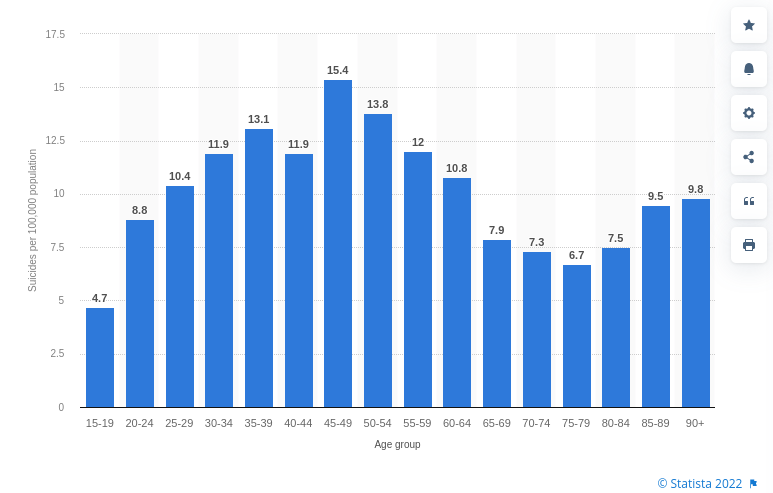
The highest age is 45-49 this is perhaps not a surprise after reading the happiness stats but it makes for a clear graph.
Please if not looked yet, read the suicide page on this website.
Divorce
Unfortunately divorce is something that you are almost certainly likely to have requested or demanded from your wife (or separation if not married) during menopause. To put the stats (that again peak at just about 47 ) in context it is typically women that start divorce proceedings at all age ranges in western culture not just at this age. The reason for this makes a little sense but can also be other factors – see these couple of paragraphs I found on the BBC website from Gilza Fort-Martinez:
Women also tend to have more close friends than men (in fact, in the US, 15% of men say they have no close friendships at all), meaning they have a better support system both to discuss any marital issues as well as to ease the transition back into single life. It’s also possible these friendships make divorce seem like a more plausible option – research suggests that if a close friend gets divorced, people’s own chances of divorcing rise by 75%.
Add this to the fact that women get primary custody of children in the vast majority of divorce cases, so women may feel they have less to lose when filing for divorce compared to men. And in some ways, they are right – evidence shows men’s wellbeing tends to drop much more dramatically immediately following a divorce.
Although this points to other reasons for a divorce (I doubt any academic institution will be brave enough to suggest a correlation with menopause anyway!) it does however highlight the need of this site to encourage men to have a better support system to cope with the situation in hand (hopefully not for the “transition back to single life”).